
Sometimes you have to build the room you belong in. A few years ago, I convened a panel after the Denver premiere of my documentary, Mary Janes: The Women of Weed. I’d filmed more than 40 women across the country for that film. About ten of them made it to the Denver premiere.
A few months earlier, the Denver Film Festival had passed on screening Mary Janes. Their short-sighted reasoning was, they’d already screened a cannabis film a few years ago, as if the story only needed to be told once. Their loss became our gain.
I rented the local Alamo Drafthouse theater myself, hired a publicist and a photographer, and sold out the venue. Afterward, three Colorado women from the film joined me on stage for a panel, moderated by a local journalist I invited.
I wasn’t fielding every question that night. I was listening, fully present, and letting the women featured in the film have their time in the spotlight. That’s commanding a room too.
How you show up on a panel tells a room whether you’re ready for the keynote stage.
Commanding a room isn’t about taking up every inch of it yourself. It’s about having enough confidence to share the spotlight, and knowing precisely what you’re signaling when you do.
It’s Not About Taking Up the Whole Room
Most advice about commanding a room tells you to do more. Speak louder. Take up more space. Move with bigger energy.
I started filming Mary Janes: The Women of Weed in February 2016. The film premiered in California and New York in October 2017. By the time I hosted the Denver premiere five months later, in March 2018, the anticipation had been building, for the local audience, the cast, and the crew who’d worked on it. I could have claimed the stage or moderated that panel myself, but I remembered Edith Wharton’s quote:
“There are two ways of spreading light: to be the candle or the mirror that reflects it.”
I chose to share the stage and reflect their brilliance.
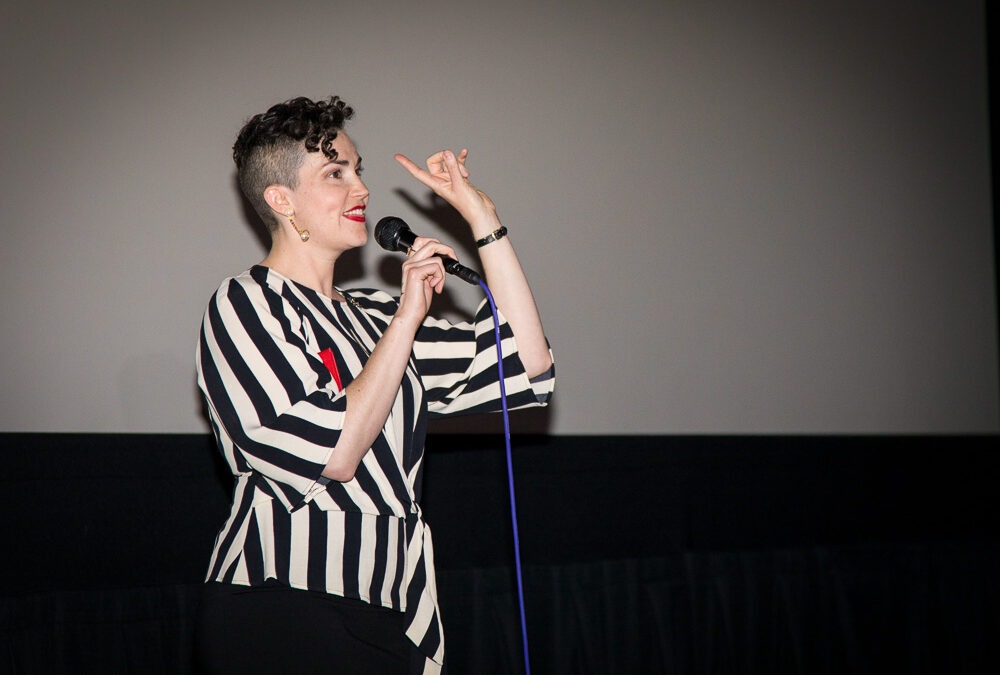
The room was buzzing when I took the stage to welcome the sold-out crowd. I encouraged everyone to stick around for the panel afterward, featuring stars from the film. The film ended to raucous applause, and no one left early. We held a fifteen-minute panel discussion, and then the audience stayed to mingle with the women they’d seen on the big screen and take photos with them.
The story wasn’t mine to carry alone that night. It belonged to the women who’d trusted me with their stories for two years, and the room needed to hear it in their voices, not mine.
By building the stage myself and bringing more chairs to it, I created a night that belonged to everyone in that room, not to a local film festival that would have pushed us out of the theater to make way for someone they deemed a bigger star. We also controlled more of the narrative: the local press ran our photos the next day, instead of burying us behind a festival headliner.
This is the same principle I wrote about in What VIBRANT Means in Leadership: presence isn’t performance, and owning a room was never about filling every inch of it with yourself.
It’s narrative architecture doing exactly what it’s built for. You can only give the spotlight away generously if you’ve built a solid foundation underneath. I’d already built the theater, the audience, the event itself. Handing over the mic that night didn’t cost me anything (besides the theatre rental and publicity fees). In the end, there was only an upside.
You’re Not the Panelist. You’re the Keynote Speaker.
I didn’t wait for a festival to hand me a stage. I offered the film premiere to the Denver Film Festival, but when they passed, I built my own. That’s the difference between waiting to be chosen for the room and deciding which room you belong in.
After 25+ years watching brilliant women get passed over, not for lack of talent, but because their story didn’t match the room they belonged in, I built the B.R.A.V.E. Framework™ to close that gap.
You’re not the diversity panelist. You’re the keynote speaker. It’s time your story reflected that.
Talent has nothing to do with it. What matters is whether your story is specific enough, unmistakable enough, that nobody can imagine filling that keynote slot, or that theater, with anyone else.
What Changes When You Do This Work
This isn’t theoretical. When a story finally matches the room someone belongs in, a few things shift and compound.
First, panels start to look different. You stop accepting every one that comes your way and start having a deliberate strategy for which invitations you accept. You know exactly what each one signals to the people doing the booking, and you start choosing rooms instead of just filling seats in them.
Your voice changes too, because your energy matches the room. You become the speaker people are still thinking about on the drive home, not the one who kept the conversation moving. That’s the same shift I wrote about in Why Executives Freeze and Fidget on Camera and How to Use a Pause to Make Your Point Memorable: the version of you that survives the edit and lands the line is the same version people remember here.
Your bookings change next. A flat, forgettable appearance rarely tanks a career on its own. But a pattern of them means the next invitation goes to someone else. A specific, memorable appearance means producers and organizers start thinking of you first.
As a result, your appearances start to compound instead of resetting to zero every time. Each panel builds toward something. Your bio, your proposal language, and your positioning all evolve, until all of it signals one thing: Keynote Speaker, not supporting cast.
And finally, most importantly, you stop being the best-kept secret in your industry. The credentials were always there. What was missing was the architecture that let people actually feel them.
Where to Start
A Signature Story starts with excavation, not writing. Think of a time when people were genuinely leaning forward. Not just politely listening.
- What were you saying?
- What did you do with the space you were given? (Your stillness, your pauses, your proximity to the audience.)
- What did you make the room feel, do, or think differently?
That memory is raw material. The story is already there. You just have to go find it. Mine started with a sold-out theater in Denver, five months of anticipation, and three women I handed the mic to instead of keeping it for myself.
Ready to Build Your Signature Story?
You’ve spent this series learning to command a room without performing for it: presence, the camera, the pause, and now, what it’s all building toward. The Fully Yourself on Any Stage worksheet takes you through the rest of the architecture, Bold, Resilient, Active, Vibrant, Expressive, until your full Signature Story is on the page.
► Get the Fully Yourself Worksheet — $44
AUTHOR BIO
Windy Borman is a documentary filmmaker, Narrative Architect, and creator of the B.R.A.V.E. Framework™. After 25+ years on both sides of the camera and the stage, she helps female and non-binary executives build the narrative architecture that gets the real version of their story from the Green Room to the Mic. Her films, including Mary Janes: The Women of Weed and The Eyes of Thailand, have screened at festivals worldwide, and her work has been featured in Variety, the New York Times, the Washington Post, Forbes, NBC, and ABC.
SERIES INDEX — READ THE FULL VIBRANT SERIES
- Post 1: What VIBRANT Means in Leadership (And What It Doesn’t)
- Post 2: Why Executives Freeze and Fidget on Camera — And What It’s Costing Them
- Post 3: How to Use a Pause to Make Your Point Memorable
- Post 4: What Commanding the Room Builds for Women Executives (you are here)

0 Comments